
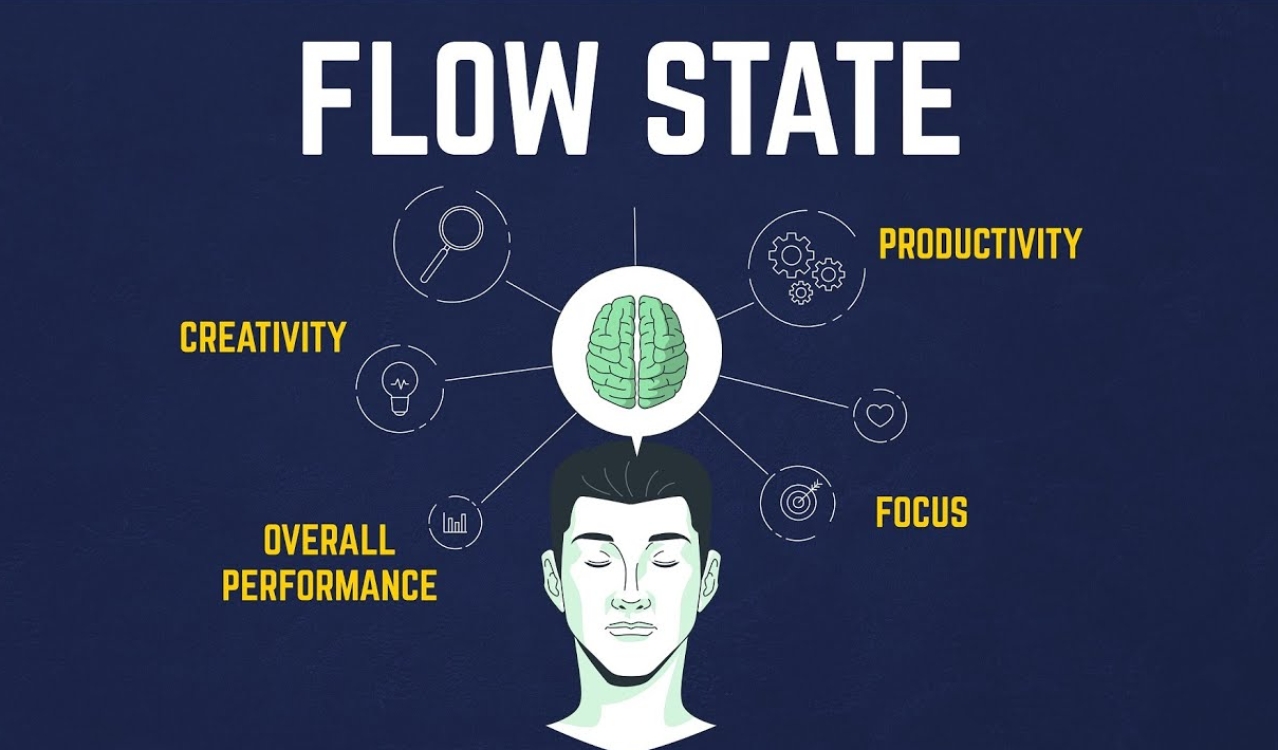
What flow state is:
Flow state is when your mind is focused on one activity. When you are in flow state, you experience a decrease in thoughts about passing of time, frustration, and self-referential thinking. This state if concentration is often referred to as ‘being in the zone’
How flow state happens:
Flow state happens when there is a perfect balance of challenge and personal skill level. This is shown in the diagram below. A highly challenging activity will require more in-depth thinking, and more effort and energy to be successful. When this is paired with a set of high-level skills and experience, you are most likely to enter flow state. This is why flow state occurs most often when an activity is:
1. Very challenging, but within your ability to complete
2. Accompanied with a sense of pride and purpose upon completion
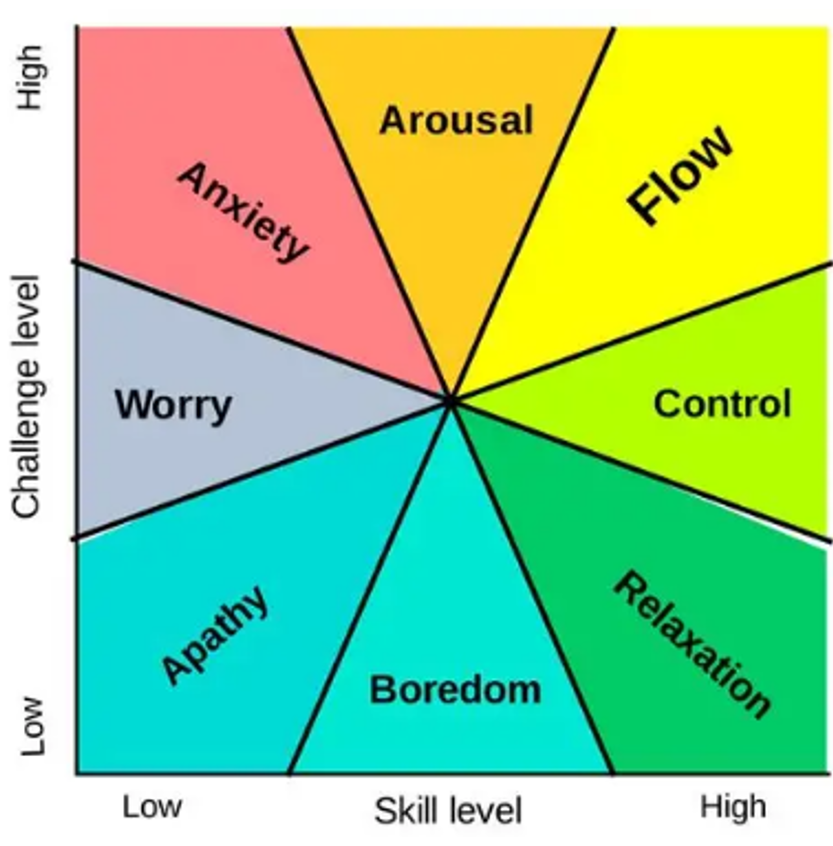
Image: Csikszentmihalyi’s flow model
Courtesy of: Neuroscience of Flow States | Encyclopedia MDPI
Flow state and neuroscience: What happens in the brain?
Scientists aren’t completely sure how the brain goes into flow state – but we have two main theories. However, we definitely know what happens in the brain during flow state
Theories regarding how the brain enters flow state:
1) Synchronization theory of flow: Some research involving neuroimaging studies shows that there is more activity in the frontal cortex. This theory reasons that your brain works together more effectively during flow. This allows you to have high executive functioning, allowing your brain to resist distractions, switch between different subjects, and memorize things easier.
2) Transient hypo frontality hypothesis: Other evidence reveals
that there is less movement in the prefrontal cortex during flow – the prefrontal cortex is heavily associated with executive functioning. This theory argues that it’s harder for different parts of your brain to communicate during flow state. This causes decreased executive functioning, which allows you to ignore self-referential thoughts and fully engage in the task at hand.
Scientific explanation of what happens in the brain during flow:
1) Dopamine: The reason we might not experience pressure or self-conscious thoughts, is a neurotransmitter called dopamine. This is able to suppress bodily sensations (tiredness, hunger, frustration)
2) LC-NE (Locus Coeruleus Norephinephrine) : Scientists believe the LC-NE system is a large factor in flow. Being in flow means that a person is fully engaged – and the LC-NE systems manages decision making and task engagement/disengagement.
Indicators of Being in Flow State:
1. Reduced self-consciousness: when in flow state, you experience a lack of self judgement and thoughts involving yourself. You cease to consider what others think about you
2. Determination: flow state diminishes frustration and discouragement. This encourages you to keep working and stay focused
3. Happiness: reward and fulfillment is associated with the flow state
A little more on the invention of flow state:
Mihály Csikszentmihalyi was the first person to create the term ‘flow state’. He was a Hungarian American psychologist, focused on positive psychology. His research on flow state proves that happiness is not decided by luck – but rather deep focus and concentration. To learn more about Csikszentmihalyi’s revolutionary research, it is recommended to read his book: “Flow, the Psychology of Optimal Experience”
Key Terms:
1. Cognitive flexibility: the ability to alternate between thinking about different concepts
2. Dopamine: a neurotransmitter associated with pleasure, reward, and happiness
3. Endogenous chemicals: a substance that is naturally made within your body, helping you perform bodily functions
4. Executive function: the management system of the brain. It allows three main things: memorization, inhibitory control, and cognitive flexibility
6. Frontal cortex: the part of your brain that is essential for high executive functioning
7. Hypo frontality: decreased activity in the frontal lobes of the brain
8. Inhibitory control: the ability to ignore distractions.
9. LC-NE (Locus Coeruleus Norepinephrine) system: A system in your brain that produces norepinephrine, which allows you to learn, make decisions, and memorize
10. Neurotransmitter: in simple terms, your brain’s messengers that send signals to the rest of your body.
References:
1. Neuroscience of Flow States | Encyclopedia MDPI
2. https://www.understood.org/en/articles/what-is-executive-function
3. https://www.theguardian.com/science/article/2024/jul/20/flow-state-science-creativity-psychology-focus#:~:text=One%20theory%20has%20been%20that,without%20deliberating%20over%20every%20decision.
4.https://www.frontiersin.org/journals/psychology/articles/10.3389/fpsyg.2021.645498/full
5. https://pmc.ncbi.nlm.nih.gov/articles/PMC7551835/
6. https://www.medicalnewstoday.com/articles/flow-state#effects-on-brain
7. Mihály Csíkszentmihályi: The Father of Flow
Thanks for reading! This article is written by the author Roseanna Wang.
Leave a Reply