Author: unboxed
-
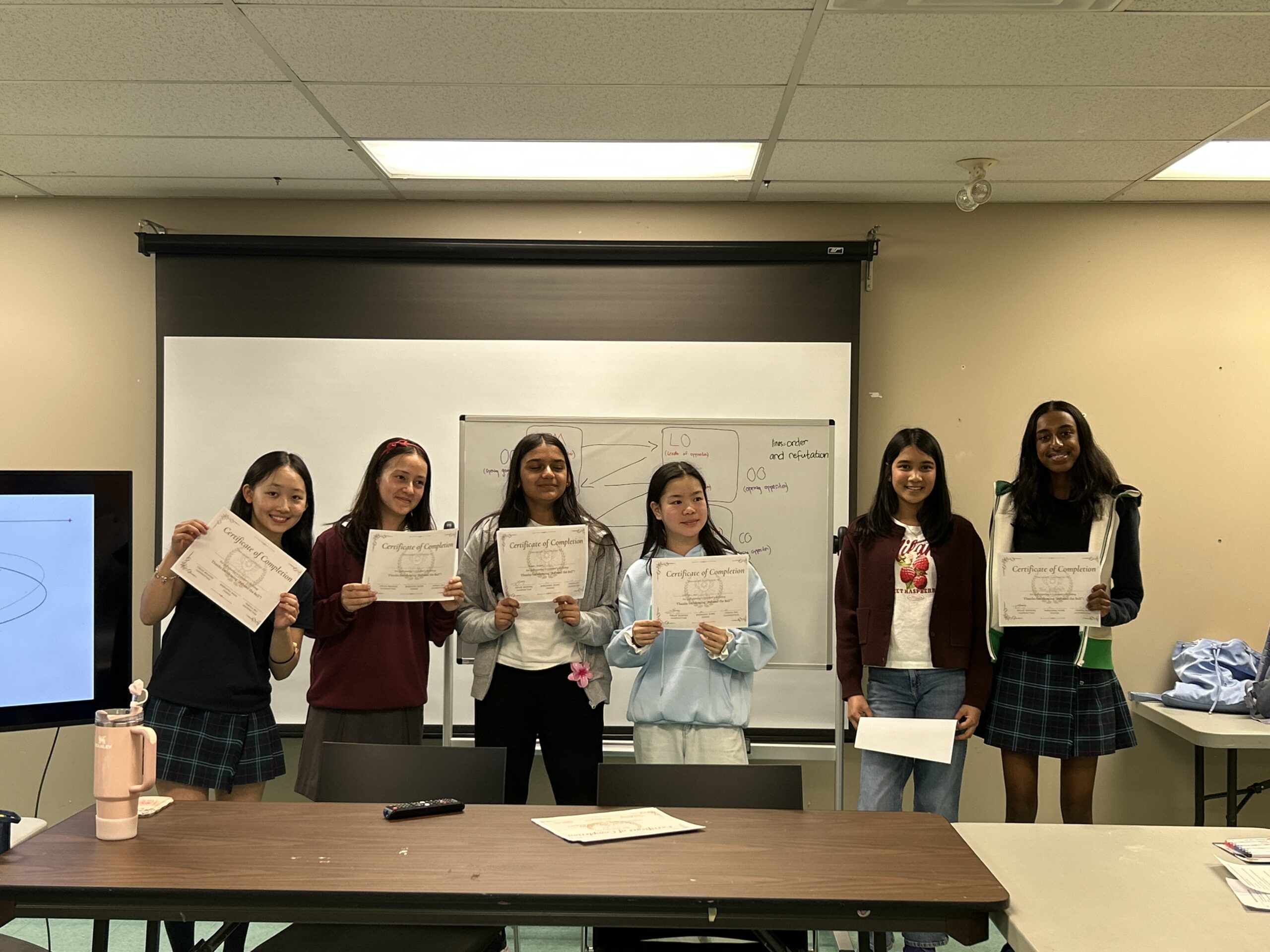
Unboxed Oakville Hosts Debate Workshop
On May 11 of 2026 at the Woodside Branch of Oakville Public Library, Unboxed hosted their first ever workshop, ‘How to Think Like a Debater’!
The Unboxed Leaders Roseanna and Chloe worked with 4 students in a two-hour British Parliamentary Debate presentation, packed with five collaborative activities.
They worked on critical thinking exercises under pressure, building strong arguments, and effectively showing why arguments are important. Here are some of the debate topics that students honed their skills in:
- Comparative weighing and weighing metrics
- Impact analysis
- Tipping point analysis
- Strategic framing and modeling
- Building strong arguments
- Types of refutation and how to use them
At the end, our students gave their first ever debate speeches, and received an Unboxed Certificate of Completion!
We are continuously amazed at students’ willingness to learn outside of the classroom – and our workshops aim to do just that – encourage like-minded, curious students to share ideas outside of school hours, and learn new things!
We look forward to the next workshop!
-

Between Faith and Equality: The Supreme Court’s Expansion of Free Exercise in Mahmoud v. Taylor
Thanks for reading! This article is written by Tobey Cai.
-
A Closer Look at the Clever and Pivotal Turning Points of the Seven Years’ War
An analysis of the Seven Years’ War by Roseanna Wang
‘Strategy is your war plan. If you go to a war without your strategy, you might not be able to defeat the enemy.’ This quote by Pooja Agnihotri proves that the most significant events that cause victory in war are the clever strategies and tactics, not famed battles. At first, the major events of the Seven Years’ War that come to mind are the Acadian Expulsion, Battle of Louisburg, and Battle of Plains of Abraham. Taking a deeper dive into the intricacy of war, it becomes known that the crucial events of war come from a root intent which forms a strategy with a lasting impact. This is why the three most impactful events in the Seven Years’ War are the ‘Join or Die’ political cartoon, Britain funding Prussia, and the Battle of the Plains of Abraham.
The ‘Join or Die’ political cartoon by Benjamin Franklin was the primary event of importance. It laid the foundation to British victory and gathered British colonies to fight. In 1754 France had a strong advantage despite Britain’s numbers; they were allied with the Indigenous and already knew how to survive winters in North America. (Theodore Michael Christou et al., 2016). Naturally, the British needed to assemble in a cooperated force against the French and their Indigenous allies. Stated by William Clarke, a British colonist, “For my own part, I cannot help thinking that unless there be a united and vigorous opposition of the British colony to them, the French are laying a solid foundation for being, some time or other, sole Masters of this Continent, notwithstanding our present superiority to them in point of Numbers.” (Theodore Michael Christou et al., 2016). This quote reflects how the British colonies were in a situation of being extremely scattered and disunified. This is also represented by the sundered snake marked with initials of British colonies, encouraging the disconnected colonies to join the army, or die the hands of the French (The Story behind the Join or Die Snake Cartoon – National Constitution Center, 2019). Overall, ‘Join or Die’ united the British army to build a stronger, cooperative force. However, the ‘Join or Die’ cartoon worked because it symbolized Benjamin Franklin’s political strategy to consolidate British forces in a cohesive opposition. Also in 1754, Franklin created an ‘Albany Plan of Union’, a proposal to strengthen British forces by creating a unified colonial government (Heimler’s History, 2020). ‘Join or Die’ was used to push forward Franklin’s plan. Although this plan was rejected at first, political cartoons were like the viral images of today; Franklin’s call for colonial unity circulated greatly and impacted countless colonists. This resulted in success when Britain won Fort Beauséjour on June 16, 1755. On July 26, 1758, the British won the Fortress of Louisburg and months later, Fort Frontenac in September and Fort Duquesne in November (Theodore Michael Christou et al., 2016). Conquering Fortress of Louisburg terminated French colonialism in Atlantic Canada, and Fort Frontenac allowed the British to gain an access point into the St. Lawrence River, as well as cut off French trading posts and supply lines. Fort Duquesne gave the British access to the Ohio River Valley. The ‘Join or Die’ political cartoon unified British colonial forces against the French and Indigenous and promoted the ‘Albany Plan of Union’, leading to key British victories
Britian funding Prussia was the second event of importance. William Pitt (British statesman and war minister) came up with a strategy to pay Prussia 133 million euros to fight their French enemies (Theodore Michael Christou et al., 2016). This plan by Pitt withdrew and divided French forces, turning the war in Britain’s favor. Since the beginning, France had an extremely strong start. Even though Britain sent over 20,000 additional soldiers to North America, the French used their forces wisely and relied on surprise attacks in small groups of people (Guerilla Warfare) (Theodore Michael Christou et al., 2016). French even successfully captured Fort Oswego (A British fort near Lake Ontario), setting the tone for triumph. Viewing this current situation, Britain needed to divert forces from France. William Pitt’s brilliant idea to support Prussia removed much of French military from North America. The Seven Years’ War was a global conflict, fought throughout the entire world for control and supremacy. In Europe, Prussia, allied with Britain, was already in conflict with Austria, France’s ally (Eccles, 2006). Luckily, France mainly focused their troops on interests closer to home in Europe. Evidence proves that “France focused its attention on fighting in Europe. This limited the number of troops it sent to defend its economic interests in North America.”(Nelson History 7). This is why France shifted focus to Europe when Britain started supporting Prussia, thinking that Britain also began focusing on Europe.
In summary, Britain funding Prussia forced France to retreat their forces to European Theatre of the Seven Years War, which benefitted the British since France had weaker defense. Aside from diminishing French resources, supporting Prussia also prevented Britain from participating in a large-scale conflict in Europe. Firstly, Britain believed that by conquering North America, they would gain greater control, than if they focused on Europe (Theodore Michael Christou et al., 2016). By funding Prussia, Britain contributed to superiority in Europe by assisting Frederick the Great (King of Prussia) to defer and neutralize enemies such as France and Austria, while allowing itself to focus its military and navy on colonial superiority in North America (Eccles, 2006). All in all, Britain deciding to fund Prussia was a crucial factor to the British victory because it shifted control over North America to the British by dividing the French opposition and contributing to conflicts in Europe while focusing on North America.
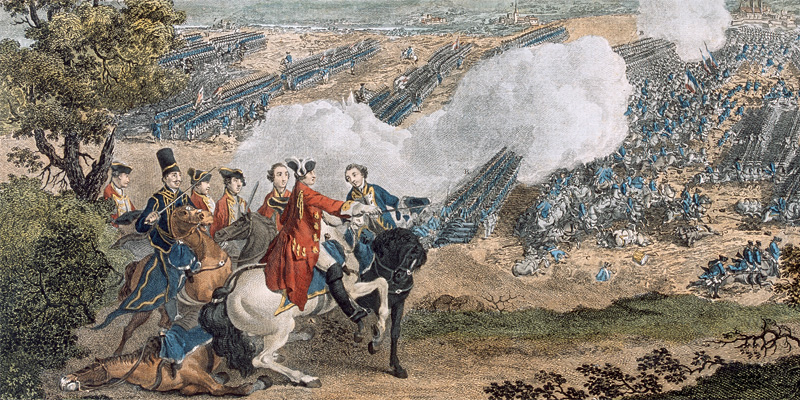
Lastly, the final event that steered the Seven Years’ War was the Battle of the Plains of Abraham. This Battle defeated the French and brought the Treaty of Paris. Quebec City was the most important target for the British. By defeating the ‘Heart of New France’, Britain would cut off French supply and communication lines and finish off the largest developed French colony. The clever strategies of James Wolfe (A British Army General) ensured Britain’s win in the Battle of the Plains of Abraham. Before attacking, James Wolfe and his army successfully captured the Isle D’Orleans, which was across the St. Lawrence from Quebec City. The first attempt to capture Quebec City failed. On Wolfe’s second attempt to win Quebec City on September 13, 1759, he stationed his troops in a cove and took small boats to Wolfe’s troops climbed a cliff under cover of darkness and surprised the French at dawn, achieving a strategic advantage on the Plains of Abraham. The French first started firing far away, but Wolfe informed his men to hold their ground. The French then got closer, and Montcalm (the French Army General) ordered his men to fire two bullets. Sadly, this was so disorganized that the bullets were much less effective than when Wolfe ordered his army to each fire one bullet right after. The battle continued for several more hours, containing both French and British deaths, including Wolfe’s and Montcalm’s. At last, the remaining French soldiers retreated and surrendered. And so, after 150 years, possession of New France was given to Britain. The French continued to fight back through the winter of 1760, but couldn’t fight off the British. They were cut off from supplies and food, and when both sides called for reinforcements, British reinforcements arrived first (Marshall, 2018). Without this well-fought battle, the British could not have won Quebec City. Finally, this battle was the cause of the Treaty of Paris. Without losing the capital of New France, the French would not have surrendered and ended the war by signing the Articles of Capitulation, which was created in 1760 and signed in 1763, successfully ending the war by signing away all French land in North America to Britain (Nelson History 7)
Strategic decisions shaped the outcome of the Seven Years’ War. Franklin’s ‘Join or Die’ cartoon united British forces, Pitt’s funding of Prussia weakened French defenses, and Wolfe’s leadership at the Plains of Abraham ended French control in Quebec. These events exemplify how strategy, not battle alone, determines victory.
References
Heimler’s History, 2020; The Story behind the Join or Die Snake Cartoon – National Constitution Center, 2019
Theodore Michael Cristou, Collishaw, R., R., Hallman-Chong, S., Hendricks, C., Armstrong, J.,
Haskings- Winner, J., Hoogeveen, M., Lee, K.-A., Mackenzie, J., & Mcclintock, M.
(2016). Nelson history 7. Student text. Nelson Education Ltd.
The story behind the Join or Die snake cartoon – National Constitution Center. (2019). National Constitution Center – Constitutioncenter.org. https://constitutioncenter.org/blog/the-story- behind-the-join-or-die-snake-cartoon
Eccles, W. (2006, February 7). Seven Years War | The Canadian Encyclopedia.
Thecanadianencyclopedia.ca; The Canadian Encyclopedia.
https://www.thecanadianencyclopedia.ca/en/articl/seven-years-war
Marshall, T. (2018). Battle of the Plains of Abraham | The Canadian Encyclopedia.
Thecanadianencyclopedia.ca. https://www.thecanadianencyclopedia.ca/en/article/battle-of-the-plains-of-abraham
Pooja Agnihotri Quote: “Strategy is your war plan. If you go to a war without your strateyg you
might not be able to defeat the enemy.” (2024). Quotefancy.com.
Thanks for reading! This article is written by Roseanna Wang.
-
Mineral Extraction Debate Notes
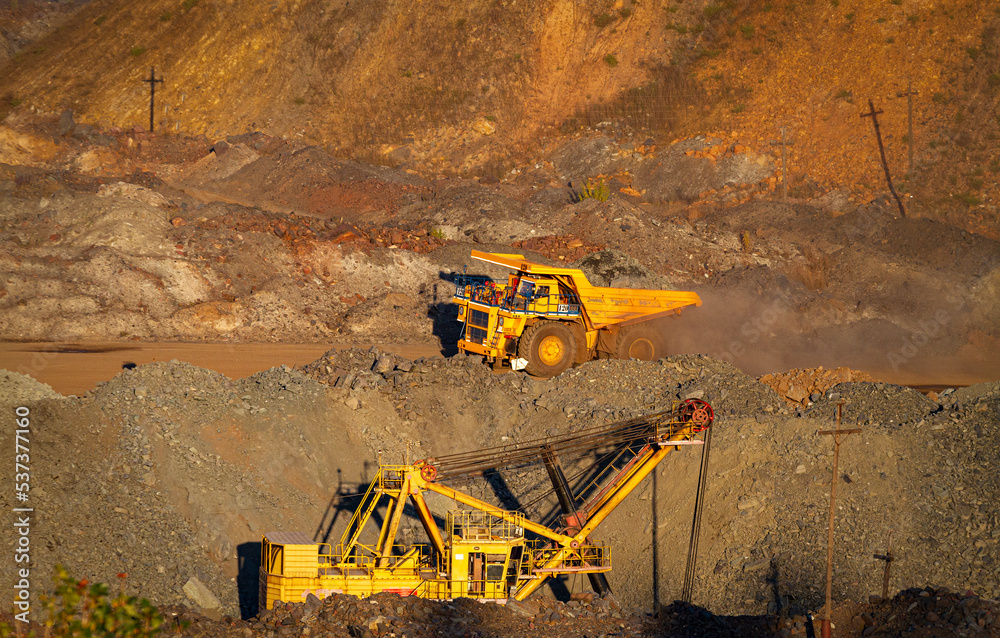
Roseanna Wang’s debate notes for the motion: This House, as Ontario, would prioritize the extraction of critical minerals in Northern Ontario over the conservation of the environment.
GOVERNMENT CASE:
Framing: Prioritization isn’t absolute: it doesn’t mean we mine everywhere and conserve nowhere, it means that we focus on development when it is important. This motion is inherently narrow and targeted: it means mining for only the scarcest minerals, the critical ones that are crucial for green technology and existing supply chains in Ontario, and the ones that are most under threat from fragile supply chains in the status quo.
What are critical minerals?
Minerals essential for modern technology and energy transition: Lithium, nickel, cobalt, chromite
Incentives and Interests of Ontario:
- accelerating responsible resource development to fortify the supply chains, workforce, and economy
- Ability to fund services for our communities
- Long-term competitiveness and energy transition
ARGUMENT ONE: Securing access to critical minerals is crucial for Ontario’s economy
There are two broad problems with status quo access to critical minerals:
- Existing supply chains are insecure. This is for two reasons:
a) Mining chains are fragmented and spread out. A battery supply chain can involve:
- Mining in one country, processing in another, cell manufacturing in a third, assembly in a fourth
- The more complex the chain, the more points of possible disruption and failure.
b) The sourcing of critical minerals is heavily concentrated in a small number of countries:
- DRC = 70% of world’s cobalt
- China dominates mineral refining
- Indonesia rapidly becoming dominant in nickel production
When chains are concentrated, countries use them as strategic political and economic leverage. If any trade tensions rise between two countries, one can impose export bans and sanctions, restrict foreign ownership, and mandate domestic processing.
- The second problem with status quo supplies is that they are insufficient: we need to expand them.
- The rapid growth in demand is outpacing supply
- Electrification, decarbonization dramatically increasing demand for EV batteries, wind turbines, solar panels, etc.
- We’re facing shortages today because after the last downturn, companies stopped investing in new mines, so supply hasn’t kept up with the recent surge in demand.
These problems harm all stakeholders in Ontario:
- On companies:
- Downstream industries (EVs, renewables, semiconductors) face immediate disruption. This is harmful since Ontario is Canada’s largest manufacturer.
- Businesses in medical tech, clean energy tech, electronics, hesitate to start because they rely on cobalt, lithium, nickel, etc. When these material’s prices and availability are unstable, it’s harder to make business plans, predict revenue, and hire workers.
- On the general population
- Jobs in Ontario become unstable (you’re in charge of assembly, but your country no longer gets supplies of materials – you lose your job)
- Electronics become more expensive – which hurts daily life, work, education
- Clean energy projects slow down
- Bad economic investment: a clean, reliable grid is a competitive advantage for attracting industrial investments, such as EV manufacturing and low-carbon steel production.
How do things improve on prop with the motion?
- More supply
- Canada produces more nickel, lithium, cobalt, etc.
- Likely more mineral refining services
Northern Ontario has places that are amazing for mining. If we mine more, it’s more likely that supply chains come closer to us.
- It’s expensive to transport raw materials across the world, so companies will choose to build refineries, battery plants, and smelters near the source.
- When governments open mining grounds, they aren’t just looking to dig up minerals, they’re looking to build their economy by making policy packages. This looks like: approving mines faster, building roads/rail to Northern Ontario, investing in processing plants.
- Ontario is the largest market in Canada for batteries/EV’S/tech companies, and now these industries can rely less on unstable supplies. It’s more likely on Gov side that the chain becomes shorter, closer, and more politically stable. Even if not fully local in Ontario, it becomes less fragile.
This leads to huge benefits that are important for Ontario:
- Jobs
- Existing business: keep alive in unstable times (companies are less likely to run out of materials or face sudden price spikes when global problems happen)
- Enable new business (easier to plan)
- Taxes
- A lot of money is generated from mining, through export revenue, income taxes, royalties. The money will go to areas that Canada needs to focus on (Ex: healthcare, we are facing staff shortages, long wait times, limited primary care)(Ex: housecare, there are high prices, low supply, fast population growth, and slow construction).
- The government has the incentive to put money in those areas, because they are top voter priorities, and governments already face budget pressures in these problems.
- End goods are important
- Energy prices stable
- Healthcare tech readily available
- Geopolitical situations and the world in the SQ is already extremely unstable (Middle East, Venezuela, Ukraine). We are likely to encounter more periods of instability in the future in addition to demand-driven supply bottlenecks.
- On proposition, we keep goods available in unstable times, we secure access to minerals into the future, we keep local jobs and businesses alive, and we enable far more to be created.
ARGUMENT TWO: Mining Revitalizes Vulnerable Communities of Northern Ontario
It’s easy for many of us to assume that environmental protection is the only priority in Northern Ontario, or that Indigenous communities are simply opposed to development. But that perspective often comes from living in places where services are stable – where schools, hospitals, roads, and businesses are already part of everyday life.
In many small and remote communities across Northern Ontario, that stability doesn’t exist.
Take the township of Fauquier (Faw queer) -Strickland, for example. It recently had to rely on a provincial grant just to maintain basic services – garbage collection, a volunteer fire department, and minimal administration. Even then, local officials have acknowledged that services will remain “bare bones for the foreseeable future.”
These communities don’t just lack essential services – they face daily challenges simply getting from place to place. Many lack reliable road access, with some roads only usable during certain seasons or not existing at all, forcing residents to depend on expensive and inconsistent air transport. This makes it difficult to access healthcare, education, groceries, and jobs, turning basic tasks into major obstacles. Limited transportation also discourages businesses from operating in these areas, reducing economic opportunities even further. As a result, young people often leave in search of more accessible communities with better connections. In towns with only a few hundred people, even one family leaving can have a significant impact on the entire community.
This isn’t just one town’s problem, it reflects a broader pattern. In small communities, people often take on multiple roles just to keep things running. A teacher might also coach sports and volunteer as a firefighter. Local businesses operate on thin margins, and even a small drop in population can force them to close.
As people leave, the consequences compound. Fewer residents mean less government funding, reduced healthcare access, and schools at risk of shutting down. And when those essential services disappear, even more families are forced to move away, creating a cycle of decline that becomes harder and harder to reverse.
Beyond economics, there is also a social cost. In small communities, people are deeply connected. I.e. your child’s teacher might also be your neighbor or a close friend. When families leave, it doesn’t just affect numbers; it weakens the social fabric of the entire community.
So the question becomes: how can this cycle be broken?
Responsible critical mineral development offers one practical path forward.
Mining projects can bring stable, well-paying jobs into regions that need them most. But the impact goes beyond employment. Increased economic activity leads to higher demand for local services like supporting small businesses, improving infrastructure, and encouraging new investment.
These developments also create opportunities outside the mining sector itself, including in construction, retail, education, and transportation. As more people stay or move into these communities, population levels stabilize, allowing schools, healthcare services, and local businesses to remain viable.
In addition, mining projects often require improved infrastructure, such as roads and energy systems, which benefit entire regions, not just the industry.
We are already beginning to see examples of this. Agreements connected to development in the Ring of Fire region, including with Marten Falls First Nation, have brought significant investment into community priorities such as infrastructure, water systems, and local facilities. These partnerships show that development, when done properly, can support both economic growth and community needs.
Ultimately, this isn’t about choosing between development and well-being. It’s about recognizing that for many Northern communities, carefully managed resource development can be part of the solution that helps to sustain populations, strengthen services, and create long-term opportunities.
How the motion changes this:
- Mining has the unique power to revitalize communities that are declining:
- Increase in jobs related to mining → Increase in workers and population → Increase in demand for services
- These workers also bring some degree of money to be spent, which helps more small businesses and services grow.
- This motion can also create job opportunities not even related to mining! (retail, construction, housing, education, entertainment)
Even better, mining requires accessible transportation, which means more building more roads for these towns.
Mining projects create an upward cycle. More jobs causes more people to want to stay.
When the population becomes stable, schools and stores stay open. Healthcare becomes accessible. Services stay alive.
- This is starting to happen in the status quo. The government gave the Marten Falls First Nation $39.5 million in exchange for its consent to build the road to the Ring of Fire. This group can now build a community centre, an upgraded wastewater system and a power line. Note that they wouldn’t have been able to do this before mineral extraction projects
Weighing:
- These benefits directly clash with any opposition arguments about the environmental concerns of local communities. The truth is, every community — Indigenous or otherwise — will have some people who support mining and some who oppose it. Yes, on prop we upset some people who hate to see the degradation of the land, but we bring benefit to the communities who want to remain close to their land. We care more about bringing jobs so people can continue to live there, because this prevents a more absolute harm.
- Of course there is environmental harm, but we don’t do it absolutely, we don’t bring every forest to the ground. There are obviously areas that remain untouched. No environmental harm is absolute.
- On opposition, the harm IS absolute, because when people move away from their communities – they’re gone – they no longer live there, so the harm is binary. As well, with every generation that moves away, the services shrink, slowly causing the area to die. On gov, we stand for the bettering of the lives of citizens in Ontario.
- Quality of life is something that affects people every day. It’s not a future risk or something ‘in theory’. It’s smth real that ppl face daily. People’s lives are directly and immediately impacted by jobs, social life, education, healthcare, and opportunities – they shouldn’t have to leave their homes to live a decent life.
- It’s a long-term good for the environment if the people living there receive education and are empowered to speak up about their rights and the environment’s rights. On OPP side, they are disempowered because we aren’t getting important education and services.
OPPOSITION CASE
Framing: Mining should still happen, but environmental conservation should not become secondary. Gov’s world includes approving projects despite environmental risks, reducing requirements, and allowing development in sensitive areas. We want a world where mining only exists with strict environmental protection, strong Indigenous consent, slower more careful development, and focus in conservation and alternatives
ARGUMENT ONE: Indigenous Communities
We stand opposed to this motion because prioritizing critical mineral extraction in Northern Ontario weakens protections that Indigenous communities rely on, both legally and historically.
First, Indigenous communities in Canada are not just stakeholders, they are rights holders. Under the Constitution Act, 1982 and reinforced by rulings from the Supreme Court of Canada, governments have a legal duty to consult and accommodate Indigenous peoples before approving projects that affect their land. This duty exists even when land claims are unresolved. Thus meaning the consultation part is not optional, it is a constitutional obligation.
Also, we have to confront reality. These obligations are often not respected when in action. There is a long and well-documented history of Indigenous voices being ignored when economic development is on the line. An example is the James Bay Project, where massive hydroelectric dams were constructed without proper consultation with Cree and Inuit communities, causing environmental damage and messy arrangement. This creates deep, lasting mistrust rooted toward governments and corporations.
Most importantly, this motion makes it easier to bypass regulations due to less oversight on this process – indigenous concerns are even MORE likely to get ignored. Let’s pinpoint an example, Bill 5 is a law passed by the Ontario government to speed up economic development by speeding up mining, infrastructure, and energy projects. It would be approving mining sites faster than before, and building roads leading to construction sites. Faster progress makes it harder to take time to consult Indigenous communities and have meaningful conversations with them about it, because gov is focused on extracting as fast as they can. Bill 5 would allow the government to put regulations in place to create zones that are exempt from provincial and municipal rules – for example, by suspending some laws that state you need to consult Indigenous and watering down rules that require respect for constitutionally guaranteed Indigenous rights. They do this by creating special economic zones where the laws that do remain can be overcome to facilitate development.
Gov is also exempting development from both ecological and archaeological assessments, which risks the destruction of First Nation burial sites, artifacts and lands. The Indigenous are spiritually connected and interdependent on these lands and show spiritual responsibility to protecting the lands and waters for future generations. The example of Bill 5 shows that this isn’t just an attack on their land – this bill spills over into other Indigenous rights, such as their culture and way of life.
So what does this motion look like then? It looks like Indigenous communities, (side note, who already struggle to have their voices heard) are even more likely to be pushed aside. It means decisions affecting THEIR land, water, and way of life are made faster, being skimmed over, and with fewer opportunities to object or try to negotiate.
This means that this is not only an environmental issue, it is a justice issue. You can’t claim to respect Indigenous rights while continuously creating systems that make it easier to ignore them.
Impacts and Weighing:
- We miss out on unique Indigenous perspectives
- Due to how environmentalism is so deeply ingrained in their culture, Indigenous groups know more about the land than many others (such as politicians and companies). By ignoring Indigenous voices, we are missing out on unique perspectives and insights they have about conservation of the earth.
- Companies don’t have as much incentive to care about long-term environmental health
- Politicians and governments lack technical knowledge or awareness of what they’re doing to the Indigenous lands.
- Yes, the government has incentives to care about the environment to an extent, but they are mostly involved in making the policies, getting the general support of the public, and executive work. The companies are the actual people acting on the laws – companies don’t have the incentive to really care about the environment because of
- CEOs make most of the decisions: CEOs care about short term profit because they are assessed on quarterly performance
- Investors/stockholders pressure companies and drive their decisions. These people care most about income, because they are putting their money into the company.
ARGUMENT TWO: Accelerating climate change and damaging vital ecosystems
Northern Ontario is largely covered by the Boreal Forest. This forest stores more carbon per acre than most tropical forests.” So when we mine these lands, we are not just extracting resources, we are releasing carbon back into the atmosphere and destroying one of our strongest defenses against climate change.
The climate change on gov side will likely be quite large:
- Mining in and of itself is harmful. It harms habitats, contaminates water systems, and disrupts fragile ecosystems that can take centuries to recover, in their best scenario that is, if they recover at all.
- Gov’s policy entails that these mining projects will be quite large. The ring of fire is one of the largest mineral deposits, and also there will be more than one
- This is a spill over effect because more people will be treating the environment poorly. Let’s consider there are not many untouched forests in the world left – if we are willingly destroying one of THE largest, it sets the precedent to other provinces in Canada, that mass mining projects like this are okay. If gov does fulfill their economic success, more mining projects will pop up
In the status quo,
- emissions are high, global warming is increasing (2024 was Canada’s warmest year on record)
- Climate change leads to health harms, harsher weather conditions and higher probability of natural disasters
- The boreal forest is the most important but most fragile ecosystem because in Canada, summer is short and winter is long and harsh – so trees grow slowly and plants take longer to recover.
With the motion:
- Mass areas of greenery will be emptied and uprooted: not just land for mining, but also for roads leading to mining sites. This fragments ecosystems and destroys habitats, disrupting biodiversity
- Water pollution increases significantly: mining requires tons of water, and leaves behind leftover ground rock, and processing chemicals that contaminate bodies of water
Why should we care about the environment?
- This isn’t just an environmental issue, it is a human related one. Biodiversity loss directly affects people. These ecosystems regulate our water, support food systems, and protect us from floods and wildfires.
- Ontario already deals with harsh weather conditions. Just imagine what it would look like if we had stronger, more frequent storms and hotter heat waves in the summer.
- Climate change doesn’t just hover over one area, it spills over into other places. If other provinces start doing this as well, the entirety of Canada faces the consequences – and this debate won’t just be about Ontario anymore.
- Climate change disproportionately impacts the vulnerable communities that Gov says they will ‘protect’ due to less resources and weaker infrastructure
- Gov is telling me that there will be economic growth – what growth will there be when you are literally worsening access to water for these people. You can’t have economic growth when you don’t have those resources that economic growth tends to target. What’s the point of having money when you don’t have clear water?
Finally, we believe that the impacts are not equal. Indigenous and rural communities, those most connected to the land are hit first and hardest. The Assembly of First Nations has emphasized that environmental degradation threatens traditional living, food security, and cultural practices.
This motion asks us to sacrifice these communities for short-term economic gain.
So let me clarify the trade-off:
On gov, they get short-term profits from mining.
On opp, we have long-term environmental stability, human health, and climate security.
Judge, once biodiversity is lost and ecosystems collapse, the damage is not just costly, it is irreversible.
We are not choosing between the economy and the environment, but more so between short-term gain vs long-term survival.
Possible Refutation:
- Engaging with Gov’s economic growth argument:
There is always some sort of exchange between the government and the Indigenous people, that promises a benefit to the Indigenous in exchange for their land or rights (i.e. mining approval in exchange for money to build a community centre) — this is not a sustainable source of funding and is likely to become exploitative in the long-term. It makes essential services depend on continued resource extraction, which creates pressure to approve harmful projects and leads to unequal, exploitative bargaining over time.
2. This motion is actually exploitative for Indigenous communities:
- Benefits (jobs, infrastructure, funding) only come when they agree to a project. This is unlike normal government funding, and can be an unstable source of income, which pressures Indigenous communities to keep approving projects
- Boom-and-bust industries like mining aren’t stable in and of itself. Prices change, projects end, companies leave. Towns in Northern Ontario show this pattern. A boom comes with jobs and money, and a bust leaves them with unemployment and damaged land.
- There is unequal bargaining power between the two groups. The government has lots of money, while the Indigenous do not.
3. Jobs created by gov are not inherently good.
a) How many people will even be able to do this job?
- Mining requires specialized training and certification (this takes a long time, and means that benefits of gov jobs aren’t equally distributed among the people)
- Many companies hire miners with experience who work on existing projects. And, how do we know that the ppl working these new jobs wouldn’t already have a job?
- Companies also fly in outside workers, such as using contractors from southern Ontario and Alberta.First of all, why is just moving people around in the economy a good thing? Second, this means the ppl who bear the environmental costs don’t even get most of the benefits
- Technology is replacing more and more labor roles. Since gov is so keen to speed up mining, they are very likely to automate most of the process
b) The jobs are unsafe
- Mining is one of the most hazardous industries. Rocks are constantly falling, there are heavy machinery accidents, explosions. On Ontario’s government website, it shows that mining in Ontario in 2020 had over 200 workplace safety complaints
c) These jobs are bad for families and communities
- Let’s be real: Northern Ontario is a really large area, and there are probably going to be other sites other than the Ring of Fire. It takes 25 hours to drive across Northern Ontario – this means workers face long commutes and long periods of separation from families, creates higher anxiety, isolation, and worse mental health
d) The jobs are contract-based and short-term.
- Mining goes through many stages: exploration, planning, construction, extraction, processing, clean-up. Although these stages collectively take years, each job does not last the whole time
- True, many jobs are administrative and aren’t involved in construction, but these jobs are temporary and contract based.
4. Gov’s impacts to community won’t happen
- We truly don’t know how long these projects are going to last. 5, 10, 20 years? It is very likely that there is not enough time for Gov to unlock their claims. Long term indirect jobs, immense economic growth and development are reached with time. What’s the point of having a population boom and more businesses and goods, when after the job is done in 5 years, they all leave? That amount of time isn’t enough to bring the benefits to Indigenous communities. As well, it is not worth using up non-renewable resources just for a few short years.
-
Battle of the Plains of Abraham; The Most Significant Event of the Seven Years’ War
An analysis of the Battle of the Plains of Abraham by Dahlia Varma
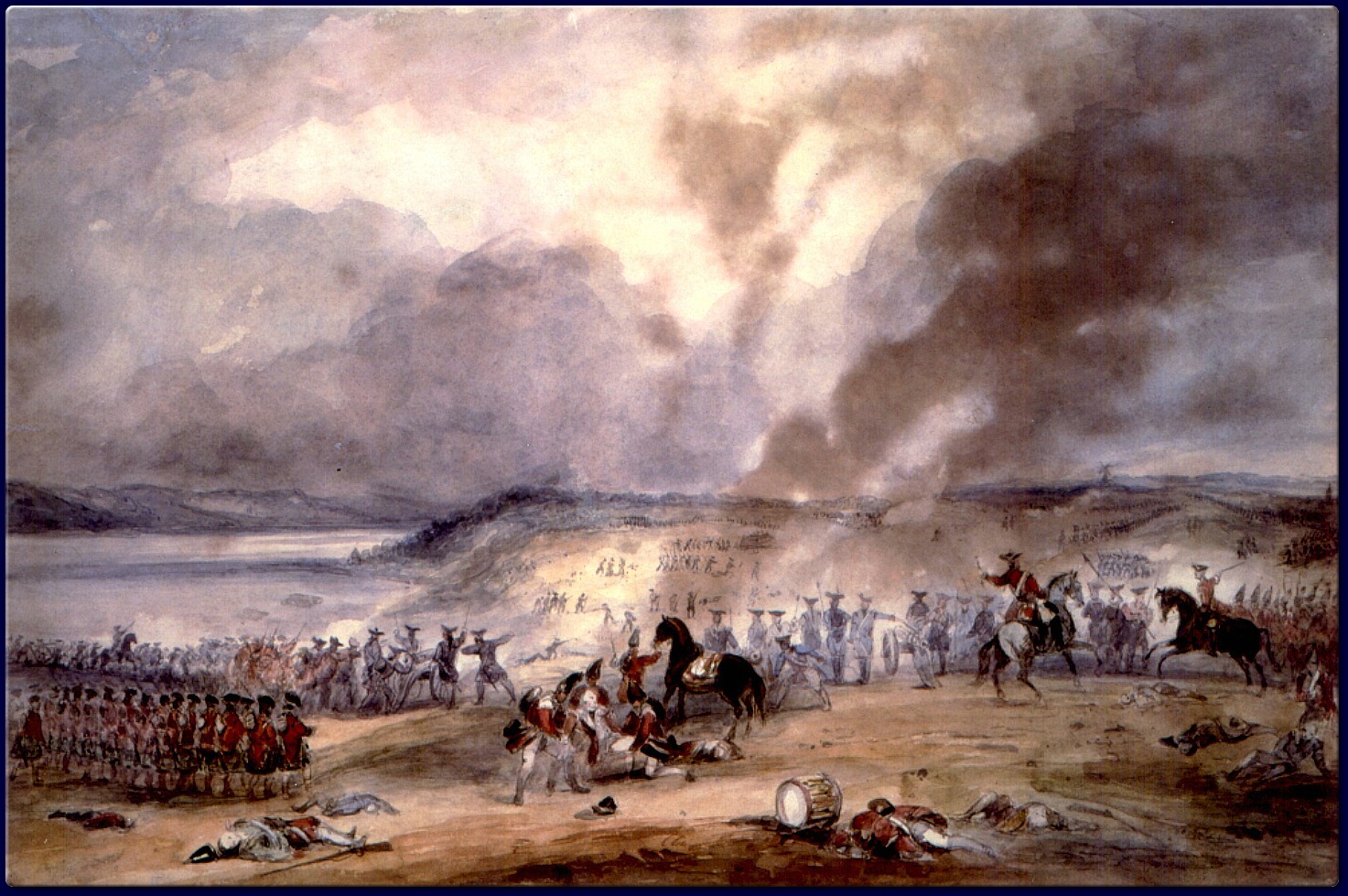
Canada, how we know it today, was shaped by the events of a single hour, on September 13, 1759. Taken place on a field in front of 65-meter-tall cliffs, a groundbreaking battle raged between the French and the British, led by some of each side’s finest commanders. The battle would decide if the French would keep Quebec, their capital and biggest settlement in North America or if the British would be able to expand their presence in North America and create a powerful country in the future. The Battle of the Plains of Abraham was the most impactful, significant event of the Seven Years War in North America for three reasons. Because of the battle, the French lost the capital of New France to the British, causing the political landscape of that area to change. To add to that, the long-term effects shaped the culture of Canada today.
Firstly, the Battle of the Plains of Abraham resulted in the French losing their capital of New France to the British. The French surrendered their city after retreating and being ambushed by British battle strategies. Proof of the British triumph happened on September 18, five days after the battle. This was when the French commander signed the Articles of Capitulation, officially turning Quebec over to the British. After this, the French settlers in Quebec fell under British rule and the rest of New France slowly disappeared without a capital. Evidence of British victory was how the French retreated into Quebec powerless when Commander Montcalm and Commander Wolfe were both mortally wounded. 640 French and 650 British soldiers were also wounded or killed. Finally, the British were able to win the battle due to clever strategies thought up by Commander Wolfe. He ordered his men to double load their muskets for the first battle fire and wait until the French got in close enough range to hit before firing. Meanwhile, the French attacked immediately, and their bullets were too far away to hit the attackers. The British hit them when they were reloading their muskets. The British strategies changed the course of the battle entirely. The Battle of the Plains of Abraham resulted in the French losing the capital of New France, with long-term effects that continue to be shown today.
Secondly, the Battle of the Plains of Abraham caused a change in politics in Upper North America. How it changed the future of laws, government, and borders made the battle the most important of all. To start, British victory of the Battle of the Plains of Abraham caused the Royal Proclamation of 1763, an act that replaced French law with English criminal and civil law. This meant that all French settlers living in Quebec had to move somewhere else or follow the laws of the British. Evidence shows that the battle gave Britain ownership over almost all Upper North America, and their laws still impact the country here today. Britain is still here through the governor general, who represents the United Kingdom in Canada’s government and how King Charles III of England is also Canada’s monarch. Lastly, the Battle of the Plains of Abraham led to a change in British laws to accommodate the French under their rule. Seven years after the Royal Proclamation, the French living under British rule realized that being Catholic prevented them from having public position. The British changed their policies in the Quebec Act of 1774 so the French would be able to practice their religion but follow British laws. These points outline how the Battle of the Plains of Abraham made a big impact on politics in Canada today.
Thirdly, the Battle of the Plains of Abraham would affect the culture and identity of settlers and the land in the future. Under British rule, French settlers would become bilingual, and their lifestyle would change but their culture would hold strong. To begin, proof shows that French settlers were taught to speak English and today, 52% of the population of Quebec can speak English. This stemmed from the Battle of the Plains of Abraham, and how the French living in Quebec were forced to change their ways. Next, British culture and trading were brought to Quebec and the rest of future Canada, thanks to the Battle of the Plains of Abraham. Much of the population at the time were to practice Anglicanism. Service and activities were also introduced to Upper North America, such as the red cross, boy scouts, and girl guides. Finally, French culture held strong, and it created a unique French society, within a larger British settled country. Because of the battle 60,000 French settlers came under British rule but today their language, religion, and culture continue to impact Canada. The Battle of the Plains of Abraham affected the culture and identity of Upper North America in the past, present, and future.
The most significant, impactful event of the Seven Years War was the Battle of the Plains of Abraham, changing the course of history forever in one hour. French power in North America was transferred to the British, proven through the Articles of Capitulation, the battle strategies of the British, and the outcomes of the battle. The political system in North America would forever be changed with the Royal Proclamation of 1763, the Quebec Act of 1774 and Britain’s influence on our country today. Finally, the culture of future Canada was developed through the English language influencing the land, the traditions and lifestyle of settlers changing, and the French culture holding strong while adapting under British rule. The country that we live in today stemmed from and was made possible by the Battle of the Plains of Abraham. Although the event itself lasted one hour, the effects that it had on North America continue to be shown through Canadians today.
References
Boberg, C. (2019). Canadian English. In The Canadian Encyclopedia. Retrieved from https://www.thecanadianencyclopedia.ca/en/article/canadian-english
de Bruin, T. (2021). Battle of the Plains of Abraham. In The Canadian Encyclopedia. Retrieved from https://www.thecanadianencyclopedia.ca/en/article/battle-of-the-plains-of-abraham
History.com Editors. (2009, November 9). Battle of Quebec (1759). History. https://www.history.com/topics/native-american-history/battle-of-quebec-1759
History Tools. (n.d.). The siege of Quebec: The battle that reshaped North America. History Tools. https://www.historytools.org/stories/the-siege-of-quebec-the-battle-that-reshaped-north-america
Miquelon, D., & Massicotte, L., & McIntosh, A. (2019). The Conquest of New France. In The Canadian Encyclopedia. Retrieved from https://www.thecanadianencyclopedia.ca/en/article/conquest
Office of the Secretary to the Governor General. (2022). Role and responsibilities. The Governor General of Canada. https://www.gg.ca/en/governor-general/role-and-responsibilities
Christou, T., Collishaw, R., Hallman-Chong, S., & Hendricks, C. (2016). Nelson History 7. Nelson Education Ltd. ch3_p.80-87.pdf
Thanks for reading! This article is written by Dahlia Varma.
-

A Journey Through the Heart of Timeless Musicals
A musical theory essay written by Verena Hui
Terrence Mann once said, “Movies will make you famous; Television will make
you rich; But theatre will make you good.” In the 1800s, European opera emphasized
orchestral music and sung-through storytelling. Stories often were about royalty, high
drama, or mythology. Later, Operettas were introduced as lighter forms of operas. They
included shorter, catchier musical numbers, and spoken dialogue. Over time, musical
theatre replaced formal styles with contemporary music, used dance and songs to
advance the plot, and included modernized themes for larger audiences.
Musical theater is a form of live theatrical performance which tells a story through
spoken dialogue, acting, dance, and songs. These elements work together to strongly
showcase emotions, engaging the audience. The principal components are designed to
develop the characters, advance the plot, and engender a mesmerized audience. The
music includes instrumental pieces as well as the songs; these advance the story and
express emotion. The lyrics are the words of the song, conveying the meaning and
emotion of the character singing the words. The choreography enhances storytelling,
and the script provides spoken dialogue which structures the show. The acting brings
everything to life, as the actors combine movement, speaking and singing in their
character.
The Sound of Music is a beloved musical by composer Richard Rodgers. The
musical tells the true story of Maria von Trapp, a young woman who becomes
governess to the seven children of Captain von Trapp. Bringing music and joy to the
family and escaping Austria as the Nazis rise. The music is by Richard Rodgers, and
the lyrics are written by Oscar Hammerstein ||. Inspiration for the musical was from the
memoir The Story of the Trapp Family Singers by Maria von Trapp, published in 1949.
The Broadway production was choreographed by Joe Layton in 1959, but the film
version was choreographed by Marc Breaux and Dee Dee Wood. The script for the
original stage musical was written by Russel Crouse and Howard Lindsay. The musical
debuted on Broadway, November 16, 1959, a major success; and the film adaptation in
1965 won 5 Oscars. There are multiple iconic songs from this musical, but “My Favorite
Things” is considered the musical number most characterized by Richard Rodgers’
musical style. It features an instantly memorable melody, something Rodgers is well
known for. Rodgers used repetition and variation, making the song easy to remember,
thus crafting lyrical tunes The song is in a waltz-like ¾ time, a rhythm Rodgers favored.
Rodgers also had a penchant for waltzes, incorporating them with an American,
Broadway style, rather than a Viennese one. Rodgers also enjoyed using a romantic
and optimistic tone. In “My Favorite Things”, this is clearly demonstrated through the
positivity of the song, producing hope and love in the musical number. The song itself
helps provide comfort to the audience in multiple ways. Many of the verses illustrate
pleasant images, for example, “raindrops on roses” or “crisp apple strudels”. The songis set in a major key, reinforcing a cheerful, comforting mood. It has a moderate tempo
which feels soothing rather than energetic. The song ends reminding the audience that
any negative feeling can turn into a positive one by recalling those simple joys. Some
themes in the song may include positivity, gratitude, and imagination. Overall, The
Sound of Music is a timeless musical combining music, joy and resilience. Filled with
memorable musical numbers, the story shows the audience how music and positivity
can keep us going even in the most difficult times.
Wicked is one of the longest-running Broadway musicals by Stephen Schwartz.
As the prequel to The Wizard of Oz, this musical tells the story of Elphaba (Wicked
Witch of the West) and Glinda (Good Witch) as former friends at Shiz University. The
story shows the two best friends of opposite backgrounds facing political corruption, and
social prejudice together, before Dorothy arrived. As both composer and lyricist,
Stephen Schwartz created the musical based on Wicked: The Life and Times of the
Wicked Witch of the West, written by Gregory Maguire in 1995. Winnie Holzman wrote
the script for the musical, and Marc Platt was the producer. The original Broadway
choreographer was Wayne Cilento, but the recent film adaptations were choreographed
by Christopher Scott. The musical premiered in 2003 on Broadway at the Gershwin
Theatre, winning multiple awards including Tony Awards. Wicked is a global
phenomenon, translated into several languages, played in multiple countries, and is one
of the most successful musicals ever. It was the inspiration for the modern film
“Wicked”, which has won numerous awards including Oscars, as well as the recent
“Wicked For Good”. The musical is full of remarkable musical numbers, but “Defying
Gravity” best represents Schwartz’s musical style. In his songs, Schwartz uses poetic
lyrics such as imagery or metaphors to enhance storytelling. “I’m flying high, defying
gravity” strongly demonstrates his ability to seamlessly combine story and message
together, providing lyrics that are motivational and symbolic. Schwartz is also known for
writing powerful vocal lines, often soaring and impactful; this is a key factor of this
song’s popularity. The song dynamically crescendos, and requires a strong chest voice,
showcasing Schwartz’s skill in building musical tension and release. The song also
features an anthemic melody that is emotionally powerful, a hallmark of Schwartz’s
compositions; it balances lyrical beauty with a dramatic impact. He also enjoyed using
rhythm to shape emotion, rather than energy. “Defying Gravity” gradually builds in
rhythmic momentum as Elphaba’s decision solidifies. The long-sustained notes instead
of strong rhythmic accompaniment help to heighten drama. The acclaimed final note is
paired with a visual spectacle, demonstrating Schwartz’s strong understanding of
musical theater. Overall, Wicked examines social injustice, identity, and choice. It
features emotionally driven music, and challenges the audience to question
appearances and judgments, showing that “wicked” is often a matter of perspective.Thanks for reading! This is an article written by Verena Hui
-
Why Smart Businesses Track Every Step of the Customer Journey
The go-to system businesses use to turn attention into long-term growth, broken down for students.
The Biggest Misconception About Marketing
One of the most common misconceptions students have about marketing is that it’s only about promoting a product and making people notice it. In reality, good marketing follows the entire customer journey—from the moment someone first hears about a brand to the point where they become a loyal, paying customer.
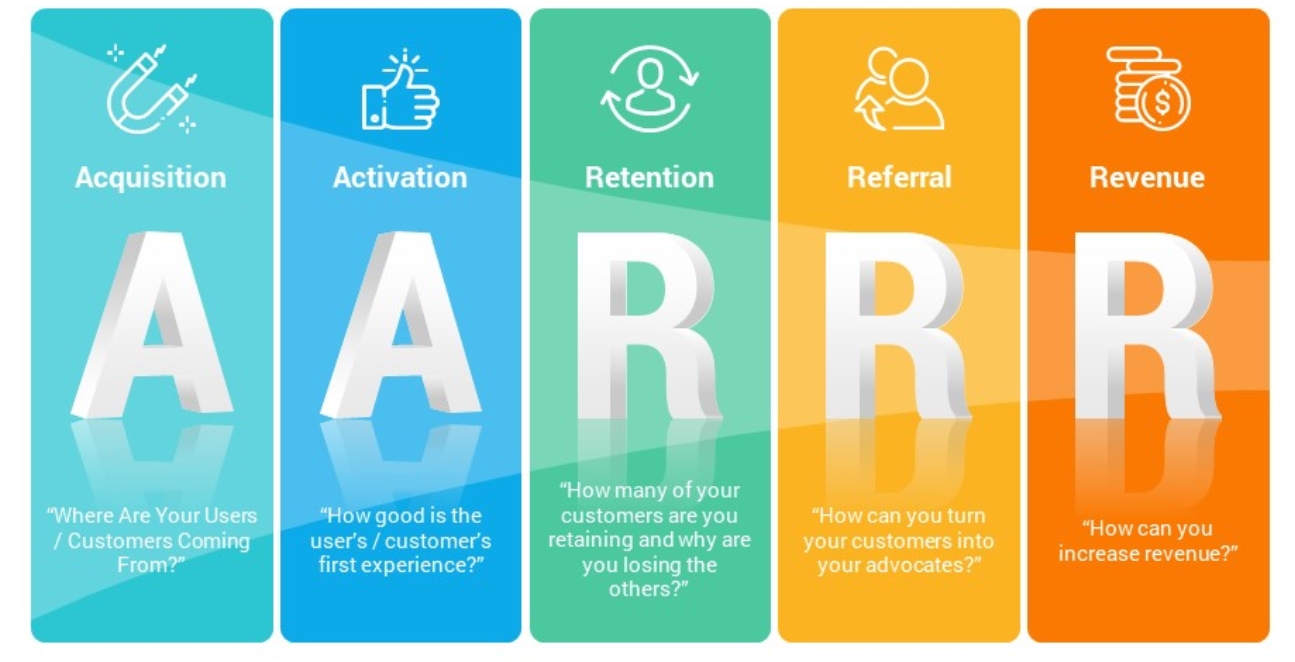
A popular framework that explains this process is AAARRR, which maps the full journey from awareness to revenue.
What Is AAARRR?
AAARRR is a framework used by companies to measure customer behavior at different stages of the customer journey. It is most commonly used in growth marketing, a data-driven and holistic approach to marketing focused on continuous improvement.
The framework consists of six stages:
- Awareness
- Acquisition
- Activation
- Retention
- Referral
- Revenue
AAARRR is also known as “Pirate Metrics”, because it sounds like a pirate’s “Arrr!” when read aloud.
How AAARRR Works: Methods and Data
At every stage of AAARRR, businesses rely on data to measure how effective their strategies are. Companies use specific tactics to move customers forward—and specific metrics to track success.
A key term used throughout this section is KPI (Key Performance Indicator).KPIs are measurable values that show how well a strategy is achieving its goal.
1. Awareness
Goal: Get more people to know that your brand exists by increasing visibility and exposure.
Methods
- Social media campaigns
- Influencer partnerships
KPIs
- Ad impressions: how many times an ad is shown
- Social media engagement: likes, comments, shares, and interactions
- Brand mentions: how often the brand is mentioned across platforms
2. Acquisition
Goal: Turn awareness into interest by getting people to take a first step, such as signing up for a newsletter or creating an account.
Methods
- Partnerships with trusted industry leaders to build credibility
- SEO (Search Engine Optimization): improving a website’s content and structure so it ranks higher on search engines
KPIs
- Traffic: number of visitors to your website or platform
- CAC (Customer Acquisition Cost): how much it costs to gain one new customer
- CTR (Click-Through Rate): the percentage of people who click after seeing an ad or link
3. Activation
Goal: Get users to take meaningful actions after their first contact with your product.
This happens after the famous ‘Aha!’ moment, when customers realize the true value of your product.
For example, Twitter realized that customers had their ‘Aha!’ moment after they gained 30 followers – once that happened, they were ‘activated’ and understood the value of Twitter. Interestingly, this is why social media accounts push customers to follow as many accounts as they can when they first sign up, so they can boost their ‘Aha!’ moment.
Methods
- Clear onboarding experiences: optimizing a user’s experience when they first use your product. This is done through welcome emails, tours of an app, and tutorials
- Guided tutorials or first-time user prompts
KPIs
- Activation rate: percentage of users who begin actively using the product after showing interest
- Early engagement: how quickly and deeply users interact after their first contact
4. Retention
Goal: Turn first-time users into returning, loyal customers.
Expert Tip:Retention is often the most critical stage in the first half of AAARRR. If users leave after one interaction, the money and effort spent acquiring them is wasted. Strong retention ensures that earlier marketing efforts are worthwhile.
Methods
- Personalized emails, notifications, and content
- Customer satisfaction surveys and feedback loops
KPIs
- Retention rate: percentage of users who continue using the product over time
- Session frequency: how often users open or interact with your app, website, or service
- Churn rate: percentage of users who stop using the product over a certain period of time
5. Referral
Goal: Encourage users to share your product with others, expanding your audience organically.
Methods
- Referral programs with incentives (rewards, discounts, prizes)
- Loyalty programs that reward users for bringing in new customers
KPIs
- Net Promoter Score (NPS): a score that shows how likely users are to recommend the product
- Referral volume: number of new users gained through referrals
- Social shares: how often your content is shared online
6. Revenue
Goal: Convert users into paying customers—and increase how much and how often they spend.
A successful AAARRR model should ultimately lead to profit by increasing the lifetime value of customers over time.
Methods
- Optimized pricing strategies (discounts, bundles, limited-time offers)
- Upselling: encouraging customers to buy a higher-end option
- Cross-selling: offering related or complementary products
KPIs
- CLV (Customer Lifetime Value): total revenue a customer generates over their relationship with the business
- ARPU (Average Revenue Per User): average revenue generated per user
Key Takeaways
- Strong marketing decisions are data-driven. Each stage of the AAARRR framework uses specific metrics to evaluate performance and guide action.
- Effective marketers track the entire customer journey. Data is continuously measured and analyzed—from first exposure to repeat purchases—to inform better decisions.
- AAARRR is a growth measurement system. It helps businesses measure things that directly impact their growth
- Retention and revenue are especially critical. Without returning users and sustainable revenue, success in earlier stages loses its value.
Think Like a Marketer
Learning begins when we apply our knowledge to the real world. Here are three critical thinking activities to use the framework we have just learnt.
- Is it possible for a company to grow revenue without improving awareness?
- A company has high awareness and acquisition, but low retention. What KPI’s can they use to analyze this problem? What methods could they implement to fix this problem?
- Choose a product that you love. What are two things this brand does to encourage activation? What methods do they use?
Key Things to Consider:
- AAARRR is not linear – it is a continuous loop of trial and error, and finding what works
- When a problem arises, consider which steps must be refined and improved
- Why might a problem arise – what might the company be doing or not doing to cause this?
References:
- What is AARRR? (2025). Growthmethod.com. https://growthmethod.com/what-is-aarrr/
- What Is AARRR? Pirate Metrics Defined. | Built In. (n.d.). Builtin.com. https://builtin.com/articles/aarrr
- Ellis, M. (2023). What Is SEO? MOZ. https://moz.com/learn/seo/what-is-seo
- The AAARRR Framework: Your 6-Step Guide To Grow A Startup – GrowthGirls – Growth Marketing Agency. (2024, June 21). GrowthGirls – Growth Marketing Agency. https://growthgirls.com/blog/the-aaarrr-framework-your-6-step-guide-to-grow-a-startup/
- Growth Division. (2025, January 30). What is the Pirate Metrics Framework? The AARRR Framework explained. YouTube.
- DinMo. (2025, February 7). AARRR: The essential growth marketing framework. Dinmo.com; DinMo. https://www.dinmo.com/marketing-strategy/data-driven-marketing/aarrr/
Thanks for reading! This article is written by Roseanna Wang
-
The Science of Flow State
What flow state is:
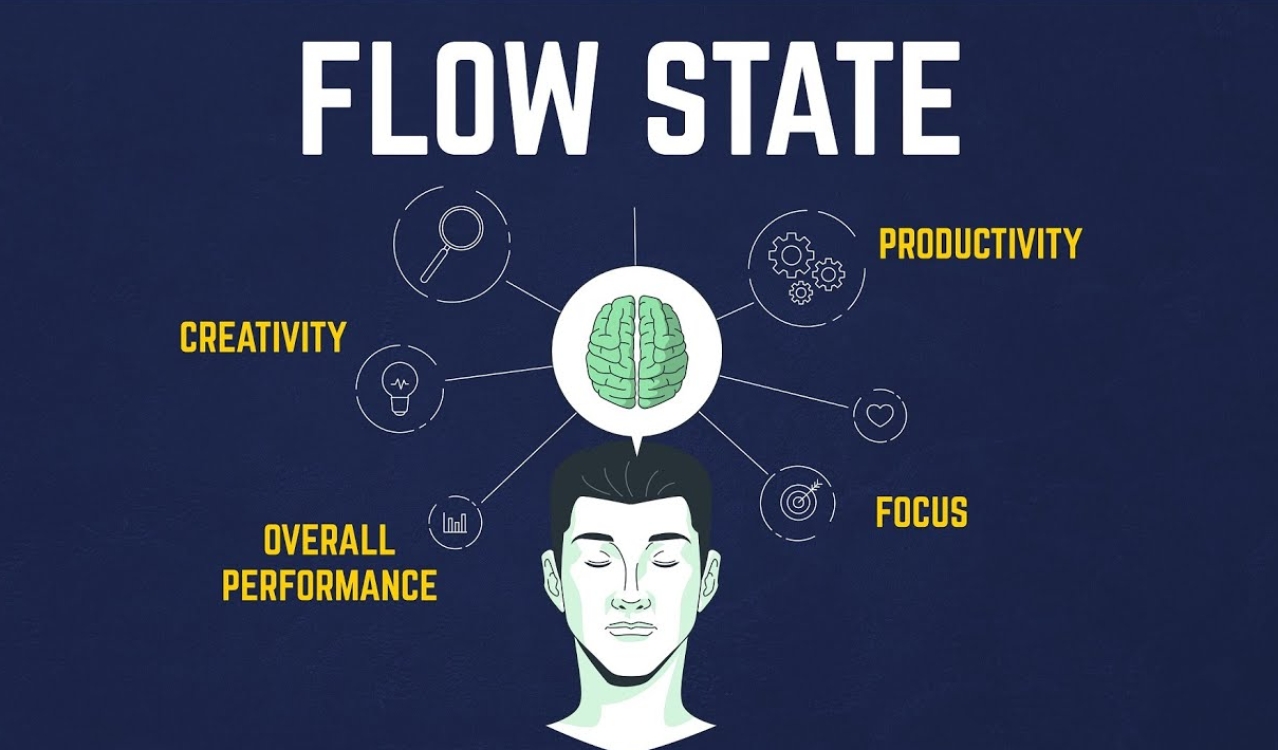
Flow state is when your mind is focused on one activity. When you are in flow state, you experience a decrease in thoughts about passing of time, frustration, and self-referential thinking. This state if concentration is often referred to as ‘being in the zone’
How flow state happens:
Flow state happens when there is a perfect balance of challenge and personal skill level. This is shown in the diagram below. A highly challenging activity will require more in-depth thinking, and more effort and energy to be successful. When this is paired with a set of high-level skills and experience, you are most likely to enter flow state. This is why flow state occurs most often when an activity is:
1. Very challenging, but within your ability to complete
2. Accompanied with a sense of pride and purpose upon completion
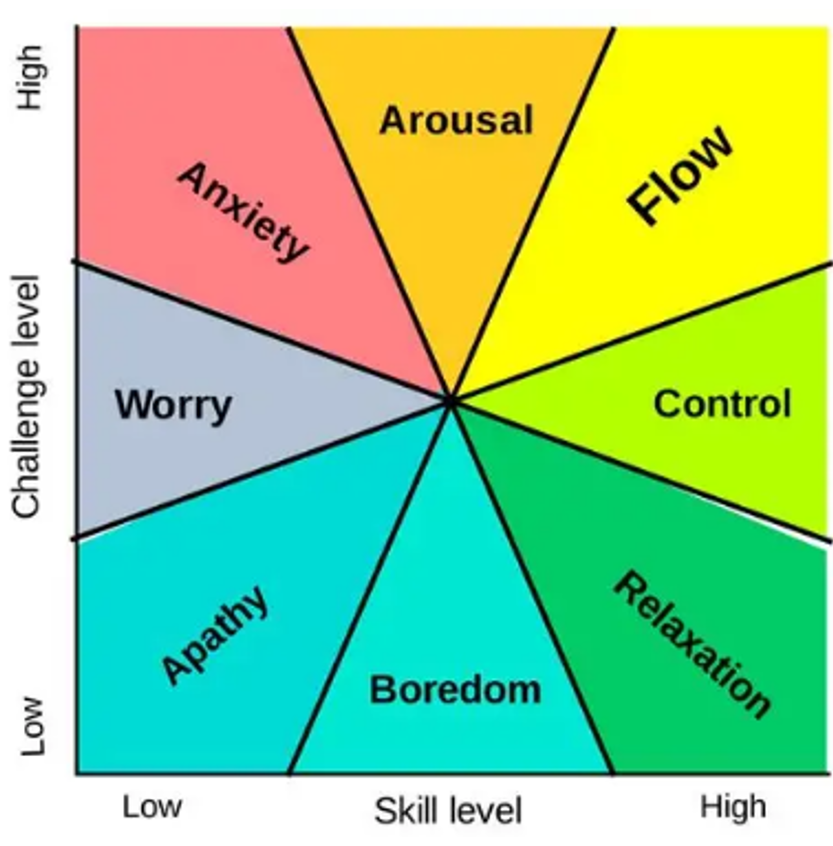
Image: Csikszentmihalyi’s flow model
Courtesy of: Neuroscience of Flow States | Encyclopedia MDPI
Flow state and neuroscience: What happens in the brain?
Scientists aren’t completely sure how the brain goes into flow state – but we have two main theories. However, we definitely know what happens in the brain during flow state
Theories regarding how the brain enters flow state:
1) Synchronization theory of flow: Some research involving neuroimaging studies shows that there is more activity in the frontal cortex. This theory reasons that your brain works together more effectively during flow. This allows you to have high executive functioning, allowing your brain to resist distractions, switch between different subjects, and memorize things easier.
2) Transient hypo frontality hypothesis: Other evidence reveals
that there is less movement in the prefrontal cortex during flow – the prefrontal cortex is heavily associated with executive functioning. This theory argues that it’s harder for different parts of your brain to communicate during flow state. This causes decreased executive functioning, which allows you to ignore self-referential thoughts and fully engage in the task at hand.
Scientific explanation of what happens in the brain during flow:
1) Dopamine: The reason we might not experience pressure or self-conscious thoughts, is a neurotransmitter called dopamine. This is able to suppress bodily sensations (tiredness, hunger, frustration)
2) LC-NE (Locus Coeruleus Norephinephrine) : Scientists believe the LC-NE system is a large factor in flow. Being in flow means that a person is fully engaged – and the LC-NE systems manages decision making and task engagement/disengagement.
Indicators of Being in Flow State:
1. Reduced self-consciousness: when in flow state, you experience a lack of self judgement and thoughts involving yourself. You cease to consider what others think about you
2. Determination: flow state diminishes frustration and discouragement. This encourages you to keep working and stay focused
3. Happiness: reward and fulfillment is associated with the flow state
A little more on the invention of flow state:
Mihály Csikszentmihalyi was the first person to create the term ‘flow state’. He was a Hungarian American psychologist, focused on positive psychology. His research on flow state proves that happiness is not decided by luck – but rather deep focus and concentration. To learn more about Csikszentmihalyi’s revolutionary research, it is recommended to read his book: “Flow, the Psychology of Optimal Experience”
Key Terms:
1. Cognitive flexibility: the ability to alternate between thinking about different concepts
2. Dopamine: a neurotransmitter associated with pleasure, reward, and happiness
3. Endogenous chemicals: a substance that is naturally made within your body, helping you perform bodily functions
4. Executive function: the management system of the brain. It allows three main things: memorization, inhibitory control, and cognitive flexibility
6. Frontal cortex: the part of your brain that is essential for high executive functioning
7. Hypo frontality: decreased activity in the frontal lobes of the brain
8. Inhibitory control: the ability to ignore distractions.
9. LC-NE (Locus Coeruleus Norepinephrine) system: A system in your brain that produces norepinephrine, which allows you to learn, make decisions, and memorize
10. Neurotransmitter: in simple terms, your brain’s messengers that send signals to the rest of your body.
References:
1. Neuroscience of Flow States | Encyclopedia MDPI
2. https://www.understood.org/en/articles/what-is-executive-function
3. https://www.theguardian.com/science/article/2024/jul/20/flow-state-science-creativity-psychology-focus#:~:text=One%20theory%20has%20been%20that,without%20deliberating%20over%20every%20decision.
4.https://www.frontiersin.org/journals/psychology/articles/10.3389/fpsyg.2021.645498/full
5. https://pmc.ncbi.nlm.nih.gov/articles/PMC7551835/
6. https://www.medicalnewstoday.com/articles/flow-state#effects-on-brain
7. Mihály Csíkszentmihályi: The Father of Flow
Thanks for reading! This article is written by the author Roseanna Wang.
-

Context, Not Quotas
An argumentative essay written by Roseanna Wang, discussing whether elite universities should prioritize merit or racial equity in admissions decisions – and which choice would lead to a fairer society.
When faced between the decision of helping underprivileged students’ access to higher education, or supporting equal treatment under uniform standards, which choice would lead to a fairer society? Universities face this dilemma every admissions cycle: should they emphasize equity or equality, race or merit? However, increasing numbers of universities are saying that neither race nor merit should be the commanding voice in elite university admissions. Merit should be prioritised, but it cannot be fully understood without considering race as contextual information that helps evaluate a student holistically. A fairer society emerges when racial equity does not replace merit but refines it, ensuring that achievement is assessed in context rather than isolation.
How Race-Based Decisions Aggravate Stereotypes
Imagine education as a marathon to the universities – yet each person belongs to a different ‘race’, with different starting points. Some begin miles behind; their race has been formed by historical inequities and unequal access to resources. For African American students in nineteenth century America, Jim Crow laws dictated segregation, and Plessy v. Ferguson justified underfunded and inferior schooling. Although legal segregation has ended, it leaves long-lasting marks: today, Black students are 3.5 times more likely than White students to attend perpetually underfinanced school districts. History has taught us that past inequality shapes access to equal education in modern times.
Race based admissions acknowledge these varied beginnings by operating on the assumption that certain racial groups must overcome greater obstacles to attain similar accomplishment. This reasoning has led institutions to adopt quotas, or treat race as the decisive factor in applications. With this approach, the doors of elite universities open to all groups, and campuses become enriched with colorful voices and dialogue. Yet, there is a fundamental flaw in this solution: they are contingent on assumptions of hardships. Not all members of a group share the same journeys, and using race as a determinant soon escalates into the assignment of stereotypes and labels to racial groups. This system creates a presumptive society that turns away equally qualified applicants for stereotypical advantage, instead of considering everyone individually.
Why Meritocracy Does Not Guarantee An Equal Chance
On the surface, putting all students in the same system – with procedural equality, uniform criteria, and identical rules – will give students a fair playing ground. Merit is measured in quantifiable achievements such as AP scores, SAT scores, GPA’s, and awards. This approach supports the narrative that as long as students worked hard, putting effort in, they could reach their goal, regardless of how they were born. But when two students write the same test, under the same rules, and same clock – but one is armed with years of dedicated tutoring and premier resources, while the other comes from understaffed classrooms – it’s clear that equality at the moment of assessment can’t compare to years of unequal preparation and different starting points. More crucially, this narrative erroneously implies that effort equals success, when success realistically depends on the opportunities you were given. The second student did not have the opportunity of a top-tier institution’s support, where teachers were happy to teach, libraries were full of books, technology was abundant, and resources were ample. When a purely meritocratic approach is taken, many capable students may never consider applying to these schools, as they have already internalized the belief that such universities are inaccessible and unreachable for them. This self-validation narrows the application pool, and in turn, decreases the diversity of perspectives in campuses. Equality at the point of assessment, while systematically fair, is inadequate in comparison to years of unequal preparation. Thus, when merit is considered in isolation, historical inequality is exacerbated instead of creating the neutral admissions pathway that was intended.
The Middleground
It is possible for equality and equity to work hand-in-hand in creating a just society through university admissions – the solution already exists. The critical need for this answer has become more urgent over the years, as more legal cases come forward. In 1978, Bakke v. Regents of the University of California was brought forth, concerning the case of an academically proficient man being rejected twice from University of California Medical School at Davis. The Supreme Court’s decision was ultimately to rescind firm quotas for racial groups, while still pursuing affirmative action through using race as a ‘plus’ factor – but only if it was part of a holistic, individualized review. The issue surfaced again in 2003, with Grutter v. Bollinger – this ruling reaffirmed the need for individualized admissions, continued seeing race as an additional factor, and rejected rigid quotas – yet Justice O’Conner declared that race affirmative policies were time sensitive, and should not be needed in 25 years. More recently, the Harvard v. Students for Fair Admissions decision overruled race-based decisions altogether, but highlighted that universities were free to use race as context to an individual’s identity as part of an individualized holistic review.
While the ‘holistic review’ framework was already existent, the idea gained popularity during Supreme Court cases about affirmative action. The concept is simple: universities would review students as more than the sum of their parts – putting equal consideration into how their identity, extracurricular activities, academic performance, and experiences contributed to their personal story. If students did not have national awards or AP classes, they would not be automatically eliminated. Instead academic achievement would be measured relative to the resources and opportunities they were given. The holistic review process paves the way for universities to see students as more than their transcript, and as their whole identity – by learning about how their unique experiences and identity has shaped them, by understanding how they leveraged their passions to impact their community, and by reading about personal growth through essays.

A Solution that Benefits All
This approach not only broadens access to higher education by addressing different foundations, but also creates a student body rich in diversity of thought, ideas, experiences, and passions – far exceeding race or merit. Furthermore, contextual admissions provide meaningful equity beyond just applying fair standards during assessments. This makes a major stride in repairing historical disparities in education, since potential is measured instead of unrealistic academic accomplishment. In this society, equality and equity walk hand in hand, and human potential, justice, and inclusion reinforce one another. Identities are celebrated and students have an equal chance of getting in for being who they are. Where such diverse opinions coexist, cooperation over shared passion allows ideas to be exchanged and challenged, transforming difference into intellectual strength.
Thanks for reading! This article is written by Roseanna Wang.