
The go-to system businesses use to turn attention into long-term growth, broken down for students.
The Biggest Misconception About Marketing
One of the most common misconceptions students have about marketing is that it’s only about promoting a product and making people notice it. In reality, good marketing follows the entire customer journey—from the moment someone first hears about a brand to the point where they become a loyal, paying customer.
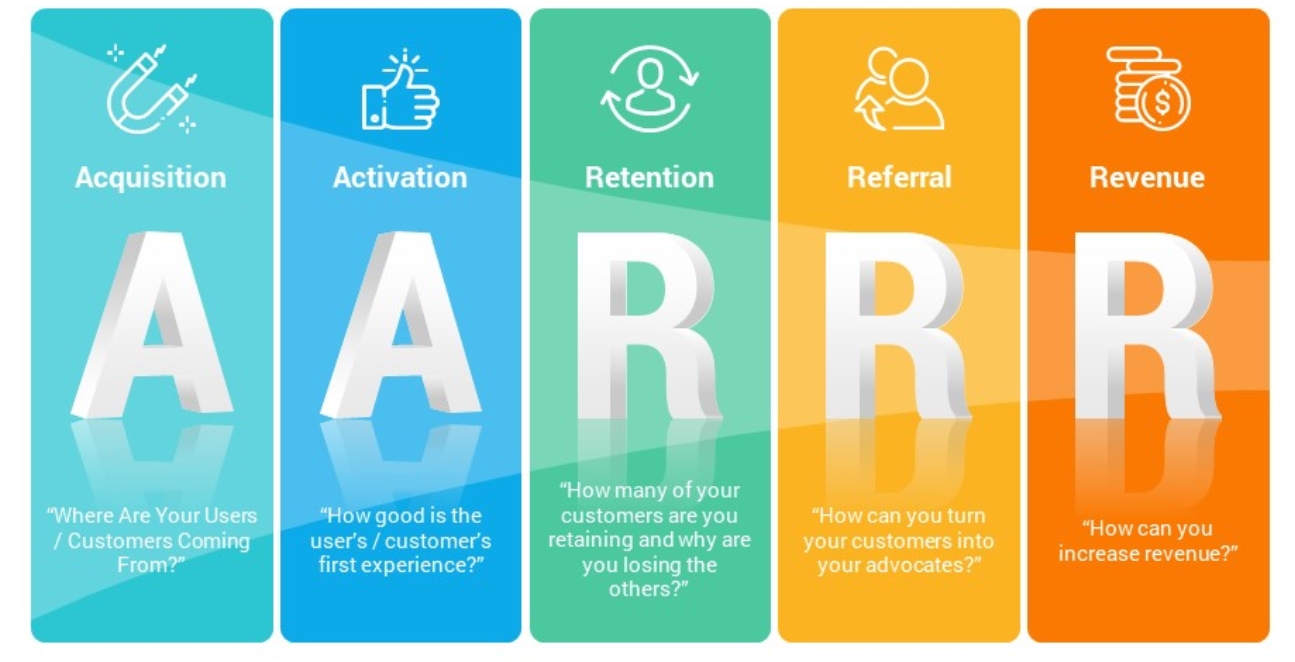
A popular framework that explains this process is AAARRR, which maps the full journey from awareness to revenue.
What Is AAARRR?
AAARRR is a framework used by companies to measure customer behavior at different stages of the customer journey. It is most commonly used in growth marketing, a data-driven and holistic approach to marketing focused on continuous improvement.
The framework consists of six stages:
- Awareness
- Acquisition
- Activation
- Retention
- Referral
- Revenue
AAARRR is also known as “Pirate Metrics”, because it sounds like a pirate’s “Arrr!” when read aloud.
How AAARRR Works: Methods and Data
At every stage of AAARRR, businesses rely on data to measure how effective their strategies are. Companies use specific tactics to move customers forward—and specific metrics to track success.
A key term used throughout this section is KPI (Key Performance Indicator).KPIs are measurable values that show how well a strategy is achieving its goal.
1. Awareness
Goal: Get more people to know that your brand exists by increasing visibility and exposure.
Methods
- Social media campaigns
- Influencer partnerships
KPIs
- Ad impressions: how many times an ad is shown
- Social media engagement: likes, comments, shares, and interactions
- Brand mentions: how often the brand is mentioned across platforms
2. Acquisition
Goal: Turn awareness into interest by getting people to take a first step, such as signing up for a newsletter or creating an account.
Methods
- Partnerships with trusted industry leaders to build credibility
- SEO (Search Engine Optimization): improving a website’s content and structure so it ranks higher on search engines
KPIs
- Traffic: number of visitors to your website or platform
- CAC (Customer Acquisition Cost): how much it costs to gain one new customer
- CTR (Click-Through Rate): the percentage of people who click after seeing an ad or link
3. Activation
Goal: Get users to take meaningful actions after their first contact with your product.
This happens after the famous ‘Aha!’ moment, when customers realize the true value of your product.
For example, Twitter realized that customers had their ‘Aha!’ moment after they gained 30 followers – once that happened, they were ‘activated’ and understood the value of Twitter. Interestingly, this is why social media accounts push customers to follow as many accounts as they can when they first sign up, so they can boost their ‘Aha!’ moment.
Methods
- Clear onboarding experiences: optimizing a user’s experience when they first use your product. This is done through welcome emails, tours of an app, and tutorials
- Guided tutorials or first-time user prompts
KPIs
- Activation rate: percentage of users who begin actively using the product after showing interest
- Early engagement: how quickly and deeply users interact after their first contact
4. Retention
Goal: Turn first-time users into returning, loyal customers.
Expert Tip:Retention is often the most critical stage in the first half of AAARRR. If users leave after one interaction, the money and effort spent acquiring them is wasted. Strong retention ensures that earlier marketing efforts are worthwhile.
Methods
- Personalized emails, notifications, and content
- Customer satisfaction surveys and feedback loops
KPIs
- Retention rate: percentage of users who continue using the product over time
- Session frequency: how often users open or interact with your app, website, or service
- Churn rate: percentage of users who stop using the product over a certain period of time
5. Referral
Goal: Encourage users to share your product with others, expanding your audience organically.
Methods
- Referral programs with incentives (rewards, discounts, prizes)
- Loyalty programs that reward users for bringing in new customers
KPIs
- Net Promoter Score (NPS): a score that shows how likely users are to recommend the product
- Referral volume: number of new users gained through referrals
- Social shares: how often your content is shared online
6. Revenue
Goal: Convert users into paying customers—and increase how much and how often they spend.
A successful AAARRR model should ultimately lead to profit by increasing the lifetime value of customers over time.
Methods
- Optimized pricing strategies (discounts, bundles, limited-time offers)
- Upselling: encouraging customers to buy a higher-end option
- Cross-selling: offering related or complementary products
KPIs
- CLV (Customer Lifetime Value): total revenue a customer generates over their relationship with the business
- ARPU (Average Revenue Per User): average revenue generated per user
Key Takeaways
- Strong marketing decisions are data-driven. Each stage of the AAARRR framework uses specific metrics to evaluate performance and guide action.
- Effective marketers track the entire customer journey. Data is continuously measured and analyzed—from first exposure to repeat purchases—to inform better decisions.
- AAARRR is a growth measurement system. It helps businesses measure things that directly impact their growth
- Retention and revenue are especially critical. Without returning users and sustainable revenue, success in earlier stages loses its value.
Think Like a Marketer
Learning begins when we apply our knowledge to the real world. Here are three critical thinking activities to use the framework we have just learnt.
- Is it possible for a company to grow revenue without improving awareness?
- A company has high awareness and acquisition, but low retention. What KPI’s can they use to analyze this problem? What methods could they implement to fix this problem?
- Choose a product that you love. What are two things this brand does to encourage activation? What methods do they use?
Key Things to Consider:
- AAARRR is not linear – it is a continuous loop of trial and error, and finding what works
- When a problem arises, consider which steps must be refined and improved
- Why might a problem arise – what might the company be doing or not doing to cause this?
References:
- What is AARRR? (2025). Growthmethod.com. https://growthmethod.com/what-is-aarrr/
- What Is AARRR? Pirate Metrics Defined. | Built In. (n.d.). Builtin.com. https://builtin.com/articles/aarrr
- Ellis, M. (2023). What Is SEO? MOZ. https://moz.com/learn/seo/what-is-seo
- The AAARRR Framework: Your 6-Step Guide To Grow A Startup – GrowthGirls – Growth Marketing Agency. (2024, June 21). GrowthGirls – Growth Marketing Agency. https://growthgirls.com/blog/the-aaarrr-framework-your-6-step-guide-to-grow-a-startup/
- Growth Division. (2025, January 30). What is the Pirate Metrics Framework? The AARRR Framework explained. YouTube.
- DinMo. (2025, February 7). AARRR: The essential growth marketing framework. Dinmo.com; DinMo. https://www.dinmo.com/marketing-strategy/data-driven-marketing/aarrr/
Thanks for reading! This article is written by Roseanna Wang